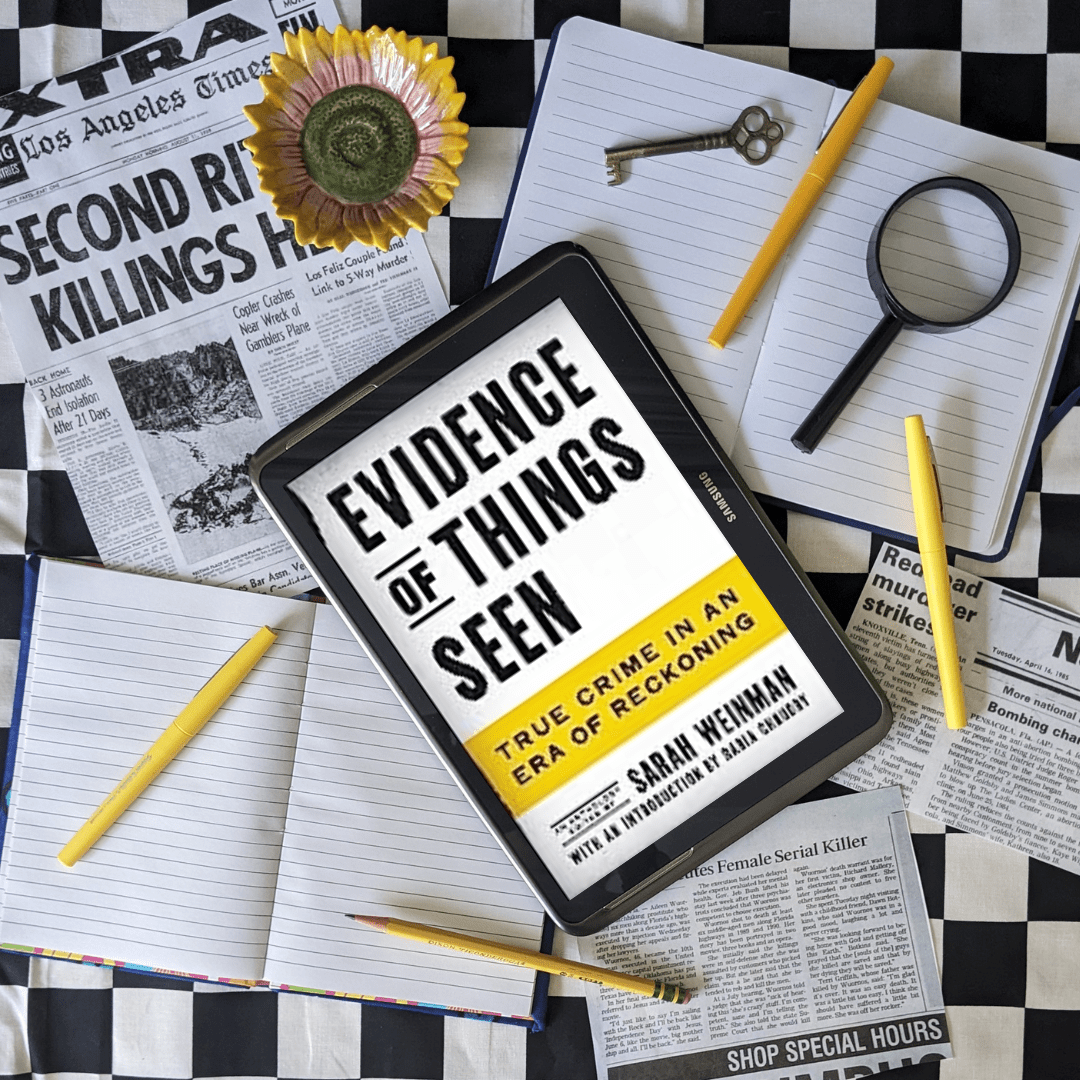
Edited by Sarah Weinman
Overall: This collection of previously published essays and articles provides an overview of what’s on the minds of writers who engage with crime and the criminal justice system in America. As someone who reads the occasional non-fiction book about crime (The Art Thief, We Keep the Dead Close, The Trial of Lizzie Borden), I wanted to see what topics I was familiar with and what I still needed to explore. Could this book help me engage with these stories in an ethical way? Some of the essays took on this topic, especially “Who Owns Amanda Knox?”. I’m glad I took a look at this quick non-fiction read, even though it didn’t deepen and complicate my understanding of the crime writing landscape quite as much as I would have liked. If you’re just starting to read about crime in modern America, though, this might be a good place to start.
Likes: Some of the articles dug deeply into topics that don’t receive a lot of attention – in particular, the essay on women in prison caught my eye. The original statistical analysis and research Justine van de Leun did for this piece, “‘No Choice But To Do It’: Why Women Go to Prison,” provided a combination of data and anecdotal evidence that was extremely compelling to me. Some of these writers are excellent storytellers creating balanced examinations of controversial topics (restorative justice for victims of domestic violence and sexual assault) or nuanced portraits of victims of crimes. The most impactful article for me was by Amanda Knox and in my opinion should be required reading for anyone interested in writing in the true crime genre.
Dislikes: The essays are uneven. While some contain fascinating statistical analysis and innovative reporting, others contain overblown language or random quotes from unattributed sources. Because this is meant as an overview, topics that are vast and nuanced sometimes receive what feels like only a glancing treatment. And I didn’t quite understand why two of the essays engaged with work largely produced during the 80s and early 90s, rather than with more recent books, articles, and podcasts. I wished more of the book had engaged with the conventions of true crime now – which I don’t think, based on my own true crime reading and listening – conform with some of the conventions of 30 years ago.
FYI: murder, violence, sexual assault, domestic violence, death of a child, lynching, racial violence, racism, substance abuse, wrongful conviction.
Thank you to the publisher and NetGalley for my advance reader copy. All opinions are my own.
 Liz Helfrich