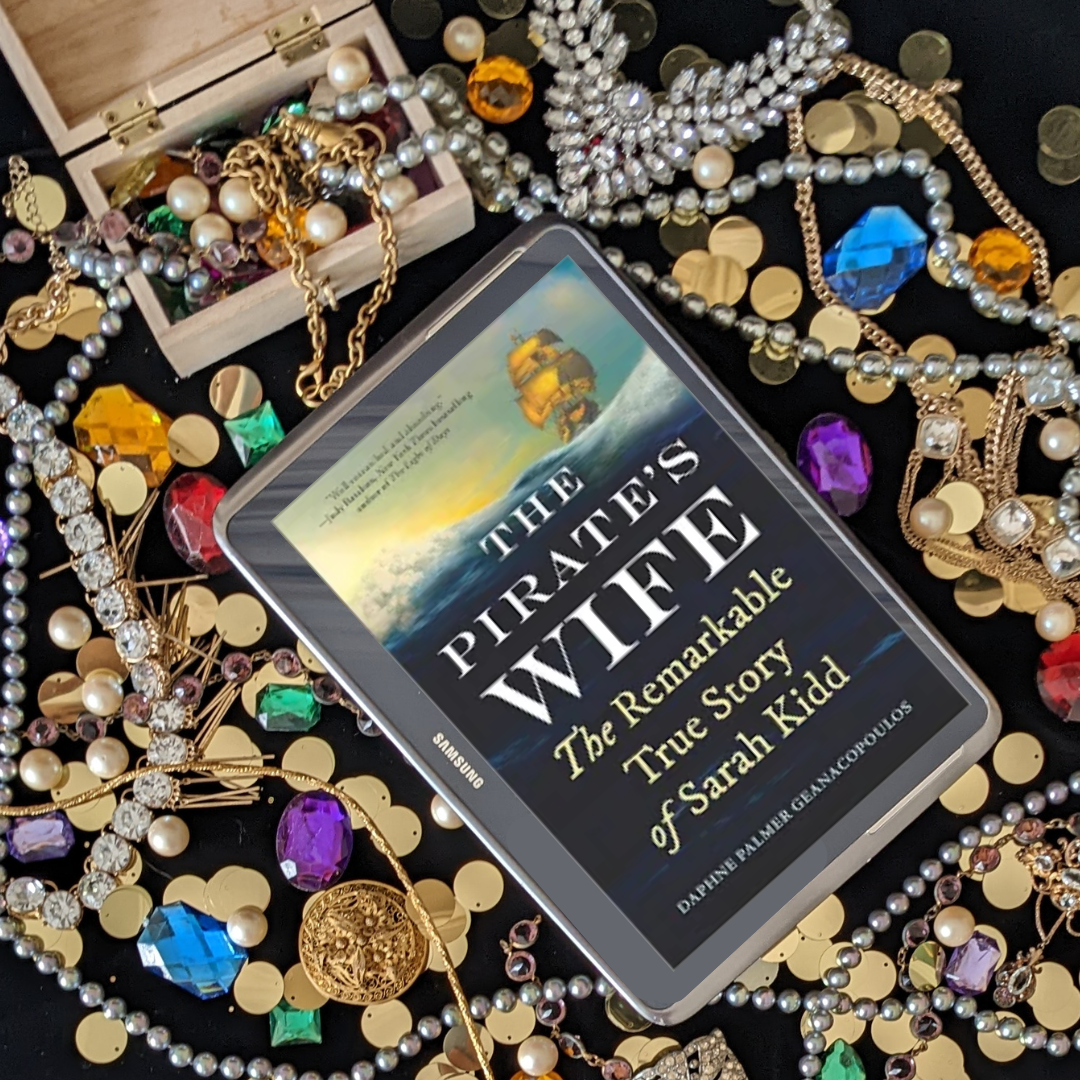
by Daphne Palmer Geanacopoulos
Overall: The Pirate’s Wife is the non-fiction account of the life of Sarah Kidd, whose third husband was the infamous Captain Kidd. Sarah lived a long and interesting life; born in England, she came to the colonies as a teenager and was promptly married off. Through her first husband, she became a wealthy woman and a merchant, and her fortunes continued to rise through her marriage to Kidd, at the time a respected sailor. The book explains the factors leading Kidd to become a pirate, shining a light on the important place piracy had in the development of the American colonies’ economies and the role the British elite had in Kidd’s rise and fall.
Likes: Geanacopoulos used an incredible number of sources, including many fascinating primary sources like Sarah’s will, to build her narrative. The details she includes, such as the items Sarah brought to her first marriage as a 15-year-old (quite young even for the time) or Sarah’s growing ability to write (as seen in her changing signature), help bring these people to life even after 400 years. The book really shines when it takes on the tension between the pirates’ peculiar brand of democracy on one hand and their deep involvement in the global trade of enslaved persons on the other. For instance, Captain Kidd made several attempts to provide for the widows and children of two pirates who died on his voyage (per the pirate code – yes, a real thing – the families of deceased pirates were owed specific payments), yet he had no problem bringing two enslaved children from Madagascar to the colonies and then into prison with him in both Massachusetts and in England as he awaited trial.
Dislikes: The prologue, in which the reader meets Sarah on her deathbed, is in a speculative and dramatic style at odds with the dispassionate, careful scholarship of the main narrative and detracted from the book. Even in the main narrative, the speculation as to what Sarah might have been thinking or feeling became distracting. A little conjecture is fine, but it reached a level that felt unnecessary.
FYI: slavery, death of a child, death of a parent, imprisonment, capital punishment.
Thank you to NetGalley and Harlequin Trade Publishing for my advance reader copy. All opinions are my own.
 Liz Helfrich